Wearing the scan: how our uniforms are built
A 3D scan of a tunic is two skins fused together. Turning it into something a soldier can wear took five fixes in a row.
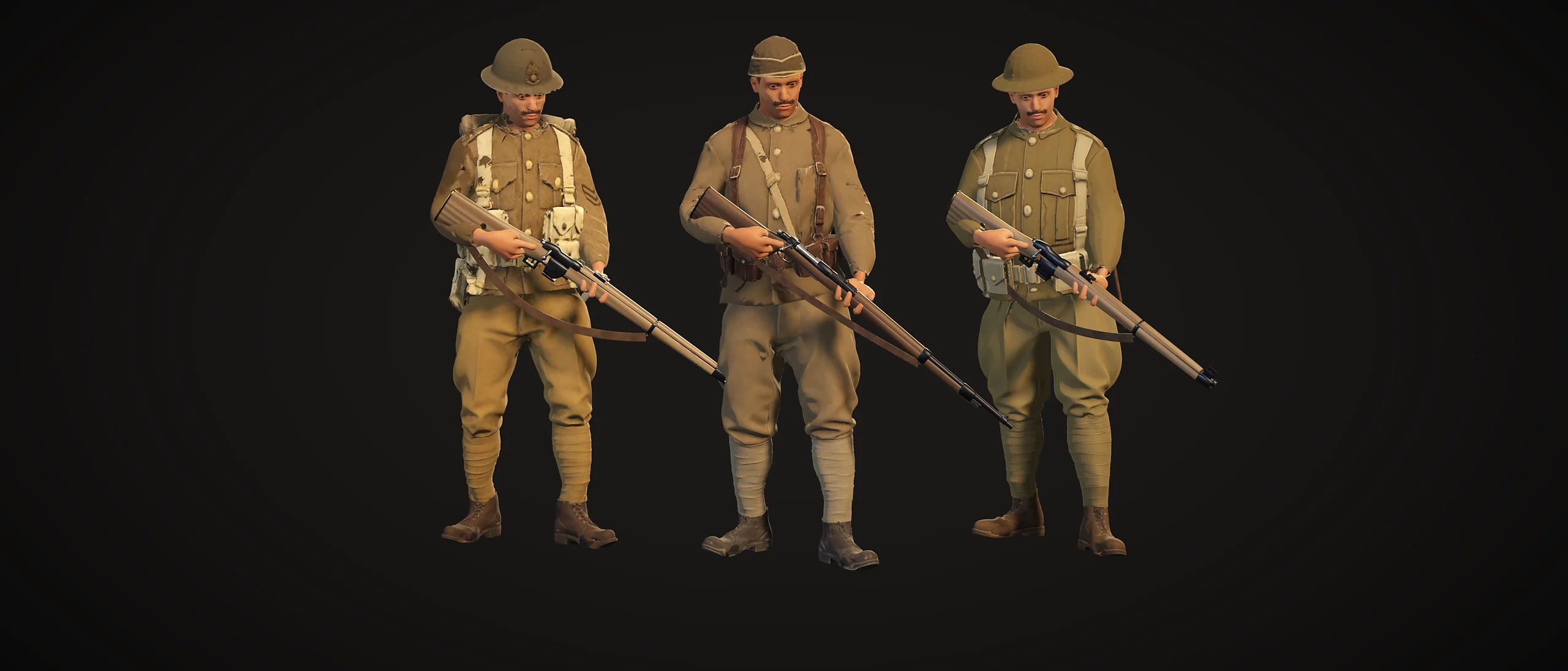
Every uniform in Tabya starts life as a reference scan: a tunic, a pair of breeches, a cap. A scan looks right from across the room, but up close it is a strange object. It is a closed shell, an outer cloth and an inner lining fused together a few millimetres apart, with its triangles wound whichever way the scanner felt like.
Two skins into one
The lining has to go: skinned to a moving body it fights its way through the cloth. Our first pass decided, triangle by triangle, which side of the cloth each face was on. On a noisy scan about one face in twenty came out wrong, and the result was a tunic with nearly five hundred holes in it and skin showing through.
The fix was to let each face vote with its neighbours. A face that disagrees with the cloth around it takes the cloth’s side, and the two skins now part along a single clean line down the middle of every fold.
The hem, the cuffs and the weights
Four more problems were hiding behind the first: a hem cut through the teeth of the scan’s fold instead of above them, a hole-filler that mistook the whole hem for a pinhole and capped it, skirt weights that tore the hem into a saw when the soldier moved, and a smoothing pass that dragged every edge vertex inward. Each one was found by rendering the tunic after every step of the pipeline and looking for the step where it went wrong.
The result is a set of uniforms that keep their shape from the collar to the puttees, on every side of the line.